Building Agentic AI Workflows: How Multi-Agent Frameworks are Changing Software Development
 Faizan
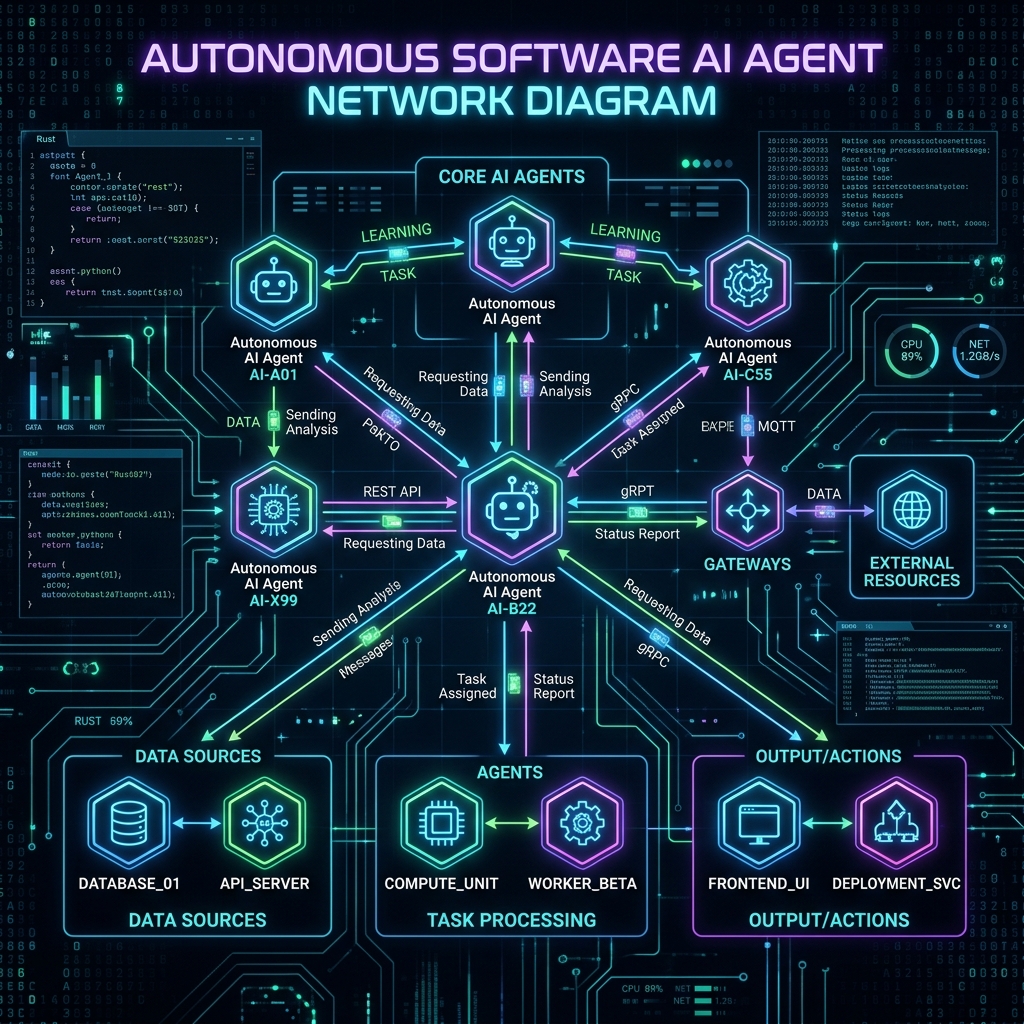
The landscape of software architecture has undergone a massive paradigm shift in 2026. Developers are no longer just writing linear code functions or making single LLM API calls. Instead, they are engineering Multi-Agent AI Systems—ecosystems of autonomous digital specialists that collaborate, critique, and execute complex business goals together.
If a single AI model is like an individual software contractor, a Multi-Agent System is like an entire agile software development squad—complete with a product manager, lead developer, QA engineer, and DevOps specialist working in harmony.
In this guide, we dive into how Multi-Agent Agentic Workflows operate, compare leading frameworks like CrewAI, AutoGen, and LangGraph, and outline step-by-step best practices for building production-ready agent networks in 2026.
Why Single-Prompt AI Falls Short for Complex Tasks
Single Large Language Model (LLM) prompts work wonderfully for simple queries, summary tasks, or short code generation. However, when tasked with building an entire full-stack web application, conducting a multi-week market audit, or managing a live DevOps pipeline, single-prompt architectures run into major bottlenecks:
- Context Window Exhaustion: Complex tasks accumulate huge amounts of intermediate data, leading to context loss, degraded reasoning, and high token costs.
- Specialization Trade-offs: A prompt optimized for creative copy writing rarely excels at strict syntax checking or database query optimization.
- Lack of Internal Critique: Without a dedicated verification step, single-prompt LLMs easily propagate errors and hallucinations throughout downstream outputs.
By breaking a large objective into discrete roles assigned to specialized agents, multi-agent orchestration solves all three problems simultaneously.
Anatomy of a Multi-Agent Architecture
Building a production multi-agent system involves four foundational concepts:
1. Role-Based Delegation
Each agent is instantiated with a specific persona, goal, back story, and set of allowed tools. For example:
- Researcher Agent: Equipped with web scrapers and search tools to collect raw data.
- Coder Agent: Equipped with shell execution tools, git integration, and linting suites.
- Reviewer Agent: Instructed strictly to find logic flaws, security vulnerabilities, and formatting issues in the Coder's output.
2. Communication Protocols (Hierarchical vs. Peer-to-Peer)
Agents must exchange messages structured in clear JSON formats or standardized Markdown queues.
- Hierarchical Networks: A Manager Agent receives the user's objective, delegates sub-tasks to worker agents, reviews worker outputs, and synthesizes the final response.
- Peer-to-Peer Networks: Autonomous agents pass messages sequentially or asynchronously along a pipeline graph until consensus is reached.
3. Shared State and Environment Memory
Agents access a shared state context graph (often implemented via Redis, PostgreSQL, or vector stores like ChromaDB). This allows agents to reference previous project decisions without clogging their immediate execution prompt context.
Popular Multi-Agent Frameworks in 2026
Developers today have access to powerful open-source and commercial frameworks designed to orchestrate agentic workflows:
| Framework | Primary Strength | Ideal Use Case | Supported Languages |
|---|---|---|---|
| CrewAI | Simple role-based setup, intuitive syntax | Enterprise business workflows & research | Python |
| Microsoft AutoGen | Flexible conversational multi-agent dynamics | Complex software engineering & simulation | Python, C# |
| LangGraph (LangChain) | Cyclic graph control, stateful execution | High-reliability, complex state machine agents | Python, TypeScript |
| LlamaIndex Agents | Deep RAG and document data integration | Enterprise knowledge management systems | Python, TypeScript |
If you are just beginning your journey into autonomous systems, read our foundational guide on Understanding Agentic AI & Autonomous Systems.
Practical Example: A Multi-Agent Content Publishing Pipeline
To illustrate how a multi-agent system functions in practice, consider an automated blog publishing workflow built with CrewAI or LangGraph:
[ User Request ]
       │
       ▼
[ Manager Agent ] ──── Assigns Tasks ──┐
       │                               │
       ├───────────────────────────────┼──────────────────────────────┐
       ▼                               ▼                              ▼
[ Research Agent ]            [ Drafting Agent ]            [ SEO Reviewer Agent ]
 (Crawls Web Data)             (Writes Article)              (Verifies Keywords)
       │                               │                              │
       └───────────────────────────────┴──────────────────────────────┘
                                       │
                                       ▼
                             [ Final Markdown Output ]
- Step 1: The Research Agent queries live search engines for the latest statistics and authoritative sources.
- Step 2: The Drafting Agent ingests the research summary and writes a structured 1,000-word post.
- Step 3: The SEO Reviewer Agent checks for proper heading tags, readability scores, and keyword density.
- Step 4: If the SEO agent finds missing subheadings, it rejects the draft and sends it back to the Drafting Agent with actionable feedback!
This internal self-correcting loop ensures that human intervention is only required for final approval.
Best Practices for Engineering Multi-Agent Workflows
When deploying multi-agent networks to production, adhere to these technical guidelines:
- Enforce Human-in-the-Loop (HITL) Checkpoints: For high-risk actions—such as sending marketing emails, executing financial transactions, or deploying production code—require an explicit human confirmation gate.
- Set Strict Recursion Limits: Limit agent reflection loops to 3–5 iterations to prevent infinite execution loops and runaway API token costs.
- Use Smaller Models for Specialist Agents: Save frontier models (like GPT-4.5 or Claude 3.7) for Manager and Reasoning agents, while utilizing smaller models (like Llama 3 8B or Mixtral) for routine formatting and extraction tasks.
- Keep Agent Tools Atomic: Design tool functions to do one thing well (e.g.,
execute_sql_query,fetch_web_page) rather than bloated multi-purpose functions.
The Future of Multi-Agent Development
As multi-agent orchestration matures through 2026, software development is transitioning from hand-coded logic to high-level multi-agent system design. Developers who master role delegation, state graphs, and tool integration will lead the next revolution in automation.
Check out our guide on AI Automation Business Models to discover how entrepreneurs are monetizing multi-agent workflows today!